
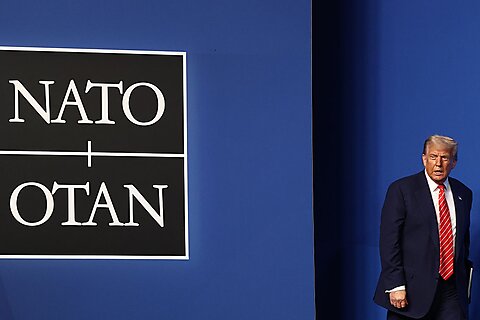

President Donald Trump has suggested that the United States should leave NATO, pointing to allies’ refusal to help patrol the Strait of Hormuz and limits on using US bases in Europe in the war against Iran. Although Trump’s reasoning is flawed—given NATO rules on engagement—his core point is sound: the US should withdraw from the alliance. It’s also a goal that many libertarians and some conservatives support.
“I think that NATO made a terrible mistake when they wouldn’t send a small amount of military armament” to support us, Trump said in late March. “NATO just wasn’t there. … We spend hundreds of billions of dollars a year on NATO protecting them. Now, based on their actions, I guess we don’t have to be, do we? … Why would we be there for them if they’re not there for us?”
Secretary of State Marco Rubio echoed that frustration: “When we need them to allow us to use their military bases, their answer is no. Then why are we in NATO? You have to ask that question. … After this conflict is concluded, we’re going to have to reexamine that relationship [with NATO].” He added, “Since Europe won’t allow us to use the bases we man and fund for their defense, we ought to close them down and remove our troops.”
At the same time, NATO’s own rules explain why allies did not respond as Trump expected. According to the alliance, “an armed attack against one NATO member shall be considered an attack against all members….” Because Iran did not attack the United States, NATO members are not obligated to assist.
Even so, the larger issue is NATO’s continued relevance. Formed in 1949 to counter the Soviet Union, the alliance now includes 32 members decades after the USSR’s collapse, with the US still shouldering a disproportionate share of the cost.
Concerns about NATO are not new. Senator Robert Taft warned in 1949 that “only Congress could declare a war,” but “under the new pact, the president can take us into war without Congress.” General Dwight D. Eisenhower—who later became president—expressed concern about a permanent US military presence in Europe. As the first Supreme Allied Commander of NATO (1951–52), he said, “If in 10 years, all American troops stationed in Europe for national defense purposes have not been returned to the United States, then this whole project [NATO] will have failed.”
After the Cold War, criticism shifted toward NATO expansion. In 1997, Ambassador George F. Kennan, a conservative and foreign policy realist, warned that expansion “would be the most fateful error of American policy” and said it “would make the Founding Fathers…turn over in their graves. … This has been my life, and it pains me to see it so screwed up in the end.”
Libertarian scholars have consistently raised similar concerns. The 1994 Cato Institute book Beyond NATO argued that if the alliance succeeded against the Warsaw Pact, “it is reasonable to ask whether it should go out of business. … Americans have every right to wonder whether it has outlived its usefulness. … The more fundamental issue is whether the alliance should exist at all.”
The Cato Handbook for Congress (2003–2005) urged lawmakers to “oppose any further expansion of the alliance; recognize that NATO has little relevance in the war against America’s terrorist adversaries; pass legislation requiring the withdrawal of all US forces stationed in Europe…; and conduct a comprehensive debate about whether continued US membership in NATO serves American interests….”
More recently, the 2022 Cato Handbook for Policymakers advised that lawmakers “abandon efforts to expand NATO” and “resume the withdrawal of US troops from Germany… and withdraw the additional 20,000 US troops sent to Eastern Europe in the wake of the Russian invasion of Ukraine.”
The strategic logic behind these recommendations is straightforward. “There is simply no good reason for the United States to be the central pillar of European security in the 21st century,” says Justin Logan, Cato’s director of defense and foreign policy studies. He adds that Trump’s skepticism—though sometimes based on faulty premises—can still be useful: “[H]e should undermine the US commitment to the alliance. Trump’s latest reason for being angry at European allies is misguided, but his tendency to distance the United States from NATO is useful—a spur to reduce Europe’s dependence on the United States.”
This perspective has gained support among some lawmakers. Senator Mike Lee, a conservative, has called for “the complete US withdrawal from NATO,” arguing that after the collapse of the USSR and the Warsaw Pact, “NATO had served its purpose.” Membership in the alliance “no longer serves US interests,” he added.
Senator Rand Paul, a conservative/libertarian, has also endorsed the idea. He wrote, “President Trump is right to strongly consider leaving NATO. I support the President’s constitutional authority under Article II to withdraw from any treaty—including NATO—without needing Senate approval.”
Scholarly analysis suggests that such a move would not be catastrophic. In his 2024 Cato Policy Analysis, Is There Life After NATO? Professor Marc Trachtenberg concluded, “The world will not end if the United States withdraws from the alliance. The Europeans, with a combined GDP (by some estimates) roughly five times as large as Russia’s, are certainly capable of defending themselves, and if America withdrew, they would have little choice but to work out some system for doing so.”
European leaders appear to be preparing for that possibility. The Wall Street Journal reported April 1 that Finland’s president, Alexander Stubb, said, “The basic message to our American friends is that after all these decades it’s time for Europe to take more responsibility for its own security and defense.”
That shift toward greater European responsibility is encouraging news—for both the United States and its allies.