

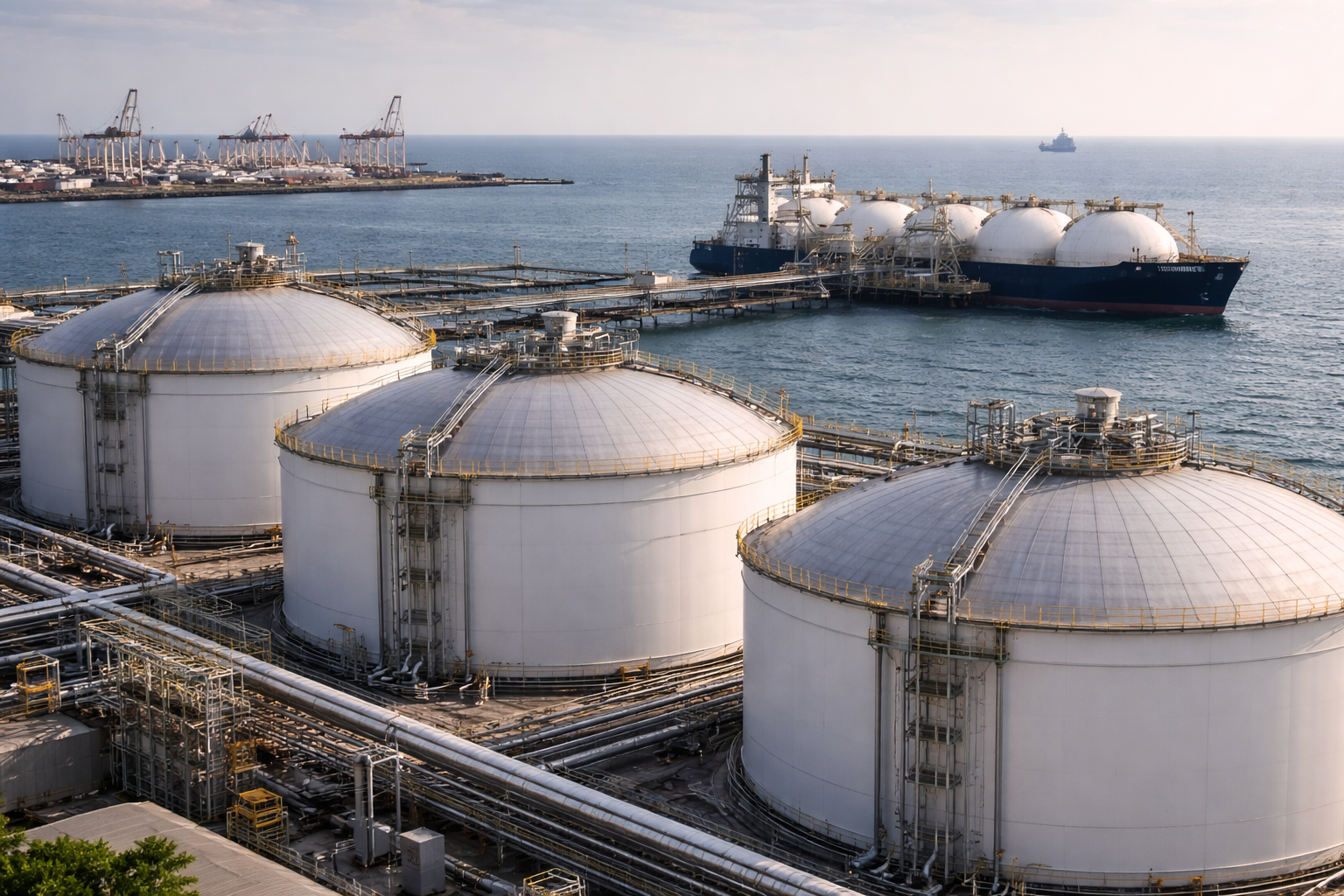
Shares of US liquefied natural gas (LNG) companies have rallied sharply amid the ongoing Iran conflict, as rising global gas prices boost near-term profitability.

However, analysts warn that sustained high prices could undermine long-term demand and complicate expansion plans for the industry.
The rally has been fueled by supply disruptions and geopolitical risks, particularly around the Strait of Hormuz, a critical chokepoint through which roughly a fifth of global LNG supply flows.
Much of this supply originates from Qatar, where damage to the Ras Laffan energy complex has removed about 25% of the country’s capacity in the year.
US LNG stocks like Venture Global, Cheniere Energy, and NextDecade have surged since the start of the conflict.
NextDecade stock has gained 8% while Cheniere Energy traded 2% higher on Thursday.
Supply disruptions drive price surge
The tightening of global supply has sent LNG prices sharply higher. Spot prices in Europe and Asia have risen 67% and 84%, respectively, since the first US strikes on Iran, outpacing the 48% increase in Brent crude.
“The gas price ramp has been the most important takeaway for markets. It suggests the underlying market dynamics are tighter than crude,” said Jefferies analyst Mike Wilson.
Further disruptions in Australia have compounded the issue. Chevron’s Wheatstone LNG plant is expected to take weeks to return to full output, while Woodside’s Karratha facility continues to face cyclone-related challenges.
Analysts estimate that up to 35 million tons of LNG supply could be lost from the market in 2026.
With global supply constrained, US LNG exporters have benefited.
Shares of Venture Global have surged more than 50% since the conflict began, while Cheniere Energy has gained about 19%. NextDecade has also climbed roughly 47%, outperforming the broader MSCI Energy index.
Analysts note that companies with greater exposure to spot pricing have seen the strongest gains, as they can better capitalize on elevated global prices.
Strong demand meets limited capacity
At the same time, demand for LNG remains firm, particularly in Europe, where storage levels are well below seasonal norms.
Inventories across the European Union were around 28% full near the end of March, with the Netherlands at just 6%, prompting early efforts to refill reserves ahead of winter.
Europe continues to rely heavily on imported LNG, and the price gap between European benchmarks and US Henry Hub prices—currently near $3 per MMBtu—has incentivized exports.
However, with US export terminals already operating near full capacity, limiting the ability to increase supply. Additional cargoes must be redirected rather than newly produced.
“If you want an extra ship of US gas in Berlin, you have to bid high enough to divert it away from Tokyo,” said Bernstein analyst Irene Himona.
The disruption of Qatari supply has also intensified competition between Europe and Asia, further driving up prices and tightening global balances.
High prices threaten long-term demand
While the current environment supports profits, higher-for-longer LNG prices could weigh on future demand growth, particularly in cost-sensitive markets.
According to Shell, LNG prices in Asia need to fall below $10 per million British thermal units to stimulate demand in India.
Current prices are roughly double that level, limiting growth. India’s LNG imports rose only modestly last year, up 4% from 2021 levels.
In some regions, even lower prices may be required. Analysts suggest prices may need to drop below $5 per MMBtu for LNG to compete effectively with coal in markets such as China, Cambodia, and the Philippines.
If prices remain elevated, countries may turn to alternative energy sources.
In Pakistan, LNG imports declined after the 2022 energy crisis, while solar installations surged as consumers and businesses shifted to renewable energy.
Governments are also reassessing energy security strategies. The current crisis may encourage greater investment in domestic energy production, renewables, or nuclear power, reducing reliance on imported LNG.
For investors, the outlook presents a mixed picture. While LNG producers are benefiting from a near-term windfall, much of this upside is already reflected in share prices. The longer-term impact of sustained high prices and shifting demand patterns remains a key risk for the sector.
The post LNG stocks surge on Mideast conflict: is demand at risk from high prices? appeared first on Invezz