
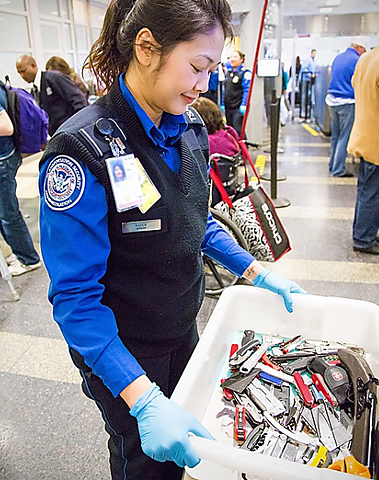

Transportation Security Administration (TSA) workers are receiving paychecks for the first time in over a month, after President Trump issued a March 27 memorandum directing the Department of Homeland Security to issue those paychecks, notwithstanding that Congress has failed to appropriate any funding for DHS since February 14.
Nobody begrudges TSA agents their back pay. It’s unfortunate that they were ever directed to work without pay in the first place. Small wonder, then, that airport security lines suffered when some TSA workers—not unreasonably—stopped showing up after weeks of unpaid labor. Passengers will no doubt welcome the shorter wait times with relief.
But these laudable aims are being achieved through means that reflect a distinct and serious breakdown in our constitutional process. Every American learns in school that Congress has the “power of the purse”—our elected representatives control the money in (taxes) and the money out (appropriations). Indeed, as Congress appears increasingly weak relative to the executive branch, the annual appropriations process is one area where members have retained some power to debate policy, negotiate compromises, and even tie the executive’s hands.
Case in point: The appropriations lapse here stems not from disagreements about the amount of DHS funding (regrettably) but from disagreements about immigration enforcement policy conditions on that funding. Whatever one thinks of those conditions, it is Congress’s power and responsibility to guide and constrain the executive branch in its exercise of the authority Congress delegates, and withholding or conditioning funds is one of Congress’s most meaningful points of leverage.
Congress can and does provide flexibility in certain appropriations, but the president’s memo makes no claim that such an authority exists here. In fact, the sole statutory citation in the memo is to 31 U.S.C. § 1301(a), which provides that appropriations “shall be applied only to the objects for which the appropriations were made except as otherwise provided by law.” (Again, no other law was referenced.) And if that didn’t make it clear that (at least a past) Congress thought its control over spending was critical, the Antideficiency Act makes it a federal crime for any government employee to spend funds in excess of the appropriated amount.
Senate Majority Leader John Thune, perhaps relying on reports from an anonymous administration official, suggested that DHS could rely on a $10 billion slush fund in the One Big Beautiful Bill Act to issue the paychecks. That seems like a stretch. Andy Craig put forward a persuasive argument for The UnPopulist that TSA operations don’t fall within the fund’s explicit limitation for activities that “safeguard the borders of the United States”: TSA screens passengers leaving airports, not arriving, and the agency operates at domestic, not just international, airports. (And if the fund’s use is legally proper, TSA workers struggling without pay and inconvenienced airport travelers would all have good cause for complaint as to why that pot wasn’t tapped sooner.)
Further confusing the legality analysis, the White House claims that the president declared a national emergency to pay TSA agents. But national emergency declarations are typically tied to the invocation of a statutory emergency authority and, pursuant to the National Emergencies Act, require the president to specify the legal provision under which he proposes to take the emergency action. None of that is found in the March 27 memo, leaving Americans in the dark not only about the source of the funding but also about whether their country is facing yet another national emergency.
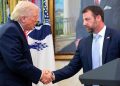
Apart from the plausibility of the administration’s legal footing, the move is another in a series of large and small blows to Congress’s diminishing role. The president’s memo asserts that “[i]f Democrats in the Congress will not act to honor the service of our TSA officers,” “then my Administration will take action.” That framing—which implies that waiting for Congress to act is simply a courtesy the president confers until he grows impatient—echoes statements made by President Obama, also on matters pertaining to immigration policy, that conservatives at the time decried for usurping Congress’s policymaking power.
These executive branch precedents accrete over time, typically at the expense of Congress. In this case, most members of Congress want to fund TSA (and the law provides that government employees get back pay after an appropriations lapse, regardless). But it’s not hard to see how this action could be used to claim authority for an executive branch action that Congress—and the American people—did not support. After all, there is no constitutional difference between a “lapse” in appropriations and a decision not to fund an activity at all (or the inability to agree whether and how an activity should be funded).
If we can no longer be confident that Congress could constrain the president through its purse strings, the Constitution’s remaining checks and balances may be too weak to function as the liberty-preserving structural safeguards on which we depend.