

Jennifer Huddleston and Christopher Gardner

Maine is set to pass legislation that would make it the first state to ban the construction of new data centers in 2027. Unfortunately, they are not alone. At the federal level, Senator Bernie Sanders has proposed legislation to enact a federal moratorium on the construction of new data centers. Eleven states have brought similar legislation to enact a moratorium on data center construction.
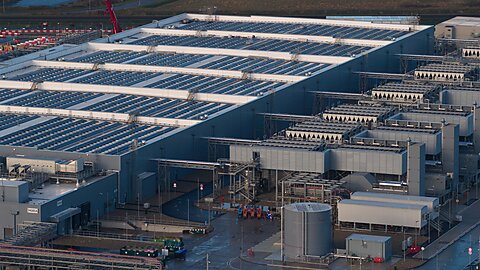
America’s innovation requires infrastructure. Trillions of dollars in investment are flowing into the construction of data centers. Opponents of this buildout point to the potential impact of data centers’ energy and water consumption on consumer utility costs. But banning the construction of data centers is the modern equivalent of threatening to ban the construction of railroads because the trains might drive up the price of coal.
Legislators at both the state and federal levels should instead consider how to better enable the market to adapt to existing energy constraints. They should also consider the broader impact that data centers have on innovation and the local economy.
What Would It Mean to Ban Data Centers
Data centers are necessary for both emerging innovations and established technologies. These facilities help power not only emerging technologies such as AI and quantum computing, but they also provide the cloud computing powering everything from our credit cards to our streaming services.
The highly sophisticated corporations constructing new data centers are responding to the growing demand for computing through investment in state-of-the-art technology. The resulting centers have benefited both the average consumer and the regional economies that have embraced them. Data center tax revenue helped residents of Loudon County, Virginia, see lower car tax bills. Mississippi’s Governor Tate Reeves has sought to create a “Digital Delta,” recognizing that while some individuals “would rather not have any industrial project in their backyard… being the hub of the world’s most awesome technology will inevitably bring prosperity and authority to our state.”
But banning data centers is about more than losing economic opportunity. It sends a concerning message that the future is not welcome by denying the necessary infrastructure to support it. To ban data centers would be to ban the next great technological revolution already improving the lives of countless Americans. AI is being integrated into our medical system to supercharge drug discovery, allow doctors to spend more time with their patients, and help speed and improve diagnoses. In our day-to-day lives, AI is being used to filter spam calls, break down language barriers, and speed up emergency services. It has also made it easier than ever to start a business, develop a new product, and make our voices heard.
A Better Approach to a Data Center’s Energy Needs
The regulatory structure of our electric grid is a core driver of increased electric costs and concerns about data center demand. Rather than banning data centers, alternative approaches would allow a state to embrace energy abundance, benefiting both our increasing technological demands and our overall energy policy approach.
Our electric grid was established over the course of the 20th century and enabled universal service at low and stable rates for consumers. However, the regulated system emphasizes reliability and consumer protection while effectively barring competitive entry, thereby incentivizing caution over speed and innovation. While this system may be appropriate for most consumers, data centers have drastically different needs. They require a constant stream of electricity and emphasize speed to power. Instead of gradual growth of 1–2% of electricity consumption per year, utilities are now facing the equivalent of plugging in a new city every time a data center is constructed.
Traditional electric utility companies are not built for this type of demand. Yet, our current regulations keep both residential consumers and the fastest-growing segment of industrial demand—data centers—tied to an industry heavily insulated from competition. This leaves homes and local businesses facing electric rate hikes. Meanwhile, data centers are forced to turn to inefficient, noisy generators to augment electric generation when the grid is stressed. By chaining the new industry to the old, existing regulations create a scenario where everyone loses.
Our Cato colleague Travis Fisher has proposed consumer-regulated electricity as a policy solution that would balance concerns about data center demand with the needs of this infrastructure for the future. His approach would free up a new market for sophisticated, well-resourced firms constructing data centers to be supplied by new, off-grid utilities able to dynamically adapt and innovate. At the same time, it ensures that none of the power required by data centers is subsidized by existing consumers, leaving traditional utilities to continue their work of providing reliable, low-cost energy.
Some states have already taken steps to implement this solution. In Ohio, the 2025 state law HB 15 has enabled developers to pursue the construction of new industry and data centers on timelines that would have been unlikely otherwise. New Hampshire’s HB 672 has fully enacted CRE, allowing independent entities to generate and sell electricity without state approval. Similar measures have been taken in Utah, Oklahoma, and West Virginia. Each showcases the promise of CRE as a serious solution to lawmakers’ concerns over rising energy prices without stifling innovation.
Conclusion
States can be laboratories of democracy, but not all experiments yield beneficial results. Artificial Intelligence represents the next great wave of American innovation. To ban or bar the infrastructure needed for the advancement of this technology is not only economically shortsighted; it is antithetical to human progress and the principles upon which America was founded.
The policy response to AI’s energy should not be to ban the construction of its infrastructure, but rather to consider alternative approaches to our current grid system. Consumer-regulated electricity is one such alternative. Lawmakers seriously engaging with the issues surrounding data centers should consider it as a policy with a proven track record for rapid increases in generative capacity without hiking rates for the average constituent.
Our current AI products are the worst they will ever be. Future products, applications, and infrastructure will improve in a variety of ways, including not only technological abilities but likely also energy efficiency. Bans could have far more long-lasting impacts than policymakers realize. The states that choose to embrace energy reform and this unique technology moment may find themselves the beneficiary of others’ policy regrets.