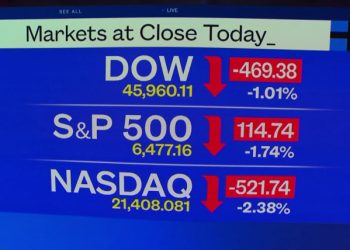


It is never a good sign when government debt auctions make the news, as was the case this week when the Treasury tried to sell $69 billion in two-year notes. Weak demand for these assets pushed their yield up to 3.9 percent. Ten-year and 30-year Treasury yields spiked, too, and all of this despite the Fed keeping its target rate unchanged at its latest meeting.
The proximate cause for the market’s suppressed bond appetite was rising inflation anxiety tied to Middle East tensions and oil prices. But this episode inadvertently illuminated something more fundamental: a hole in one of the Federal Reserve’s favorite defenses of its interest on reserves (IOR) program.
The Fed’s Substitution Argument
The Fed currently pays banks a risk-free administered rate on trillions of dollars in reserve balances through the IOR framework. When Congress or outside critics raise the cost of IOR, the Fed has a ready response. Its own FAQ webpage on the subject states that if a bank held Treasurys instead of reserves, “the bank would still earn interest paid by the government—both Treasury securities and reserves are government liabilities—and there would be no net effect on interest earned or paid by the government.”
In short, the Fed argues that IOR and Treasurys are fiscal equivalents. Remove IOR, and banks would simply shift into Treasurys. The government would pay interest either way, and taxpayers would be no better off. The substitution argument treats Treasury securities and reserve balances as interchangeable assets that banks would hold at identical yields. But that is not how markets work, nor is it how banks make investment decisions.
We have critiqued this argument and several others in the past, but Tuesday’s auction offers a real-time case study of why this substitution argument is wrong.
Markets Price Risk and Send Signals. IOR Does Not.
When the Treasury auctions securities, it does not set the yield. The market does. Investors, including banks, assess duration risk, inflation risk, liquidity needs, and opportunity costs, and then bid accordingly. If they think the offered yield is too low relative to those risks, they simply don’t bid, or they bid less aggressively. That is precisely what happened at this week’s auction. Inflation uncertainty made investors skeptical that the two-year note was fairly priced, and the auction showed it.
IOR operates entirely differently. The rate is set administratively by the Fed’s Board of Governors. Banks don’t bid; there is no market or auction for these funds. Correspondingly, there is no price discovery nor any mechanism by which banks can signal that the rate is suboptimal. Reserves are overnight liabilities of the Federal Reserve, not term obligations subject to duration or inflation uncertainty. They are, by design, the safest asset in the financial system guaranteed by the Fed’s ability to simply add numbers to banks’ accounts (as inadvisable as it may be to do so).
This is the flaw in the substitution argument. It assumes that if IOR were eliminated, banks would absorb trillions in Treasury securities at whatever yield prevailed, bidding rates down until Treasurys became equivalently attractive. But banks are optimizing investors. They demand compensation for risk. A two-year (or longer) note carries meaningful inflation and duration risk; an overnight reserve balance does not. These are not the same instrument, and rational investors do not price them identically. That price is a signal; while that signal may be costly to the Treasury, it is informative.
The Bottom Line
IOR imposes no market discipline. The rate is set by the same institution that controls monetary policy, paid to the same banks that are counterparties to Fed operations, and bears no relationship to market pricing. It is a transfer, administered by fiat, insulated from the price discovery that makes Treasury markets meaningful. Treating these two instruments as equivalents, as the Fed’s argument requires, ignores economic and institutional differences.
This week’s auction was just an example. It showed that investors care about the conflict in the Middle East. If they were to engage in further Treasury auctions with the money they currently park at the Fed to receive IOR, it might reveal a host of other important signals. For instance, we may discover (as markets demand higher yields) that people have a limited appetite for US debt if the federal government shows no signs of ending its fiscal profligacy. As it stands, the government can simply have the Fed monetize its unending debts under the cover of IOR.
This week’s auctions were, on the surface, a story about oil prices and Middle East risk premia. But it was also a reminder that investors don’t passively accept whatever yield the government puts in front of them. IOR is not a perfect substitute for Treasurys. Pretending they are the same is not a defense of sound monetary policy. It’s a rhetorical sleight of hand.