

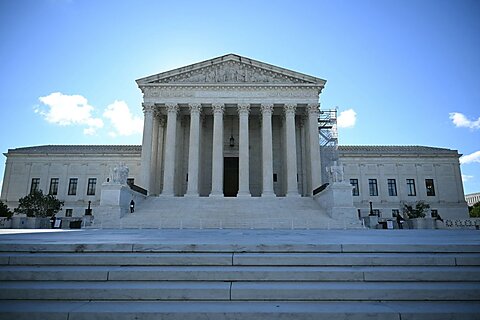

Yesterday, the Supreme Court decided Barrett v. United States. While the decision, written by Justice Ketanji Brown Jackson, was virtually unanimous (apart from a disagreement about a few citations to legislative history), in the background lurks a dispute among the justices over whether Congress or the Constitution should drive the reach of double jeopardy protections.
The Fifth Amendment’s Double Jeopardy Clause provides that no person shall “be subject for the same offense to be twice put in jeopardy of life or limb.” In other words, a criminal defendant can’t be punished more than once for the same crime. Complications arise because sometimes the same act can violate several different criminal laws. Consider a woman who stabs a teller during a bank robbery: Can she be convicted of both bank robbery and aggravated assault? Or what about a man who punches a police officer: Can he be guilty of two separate crimes of battery and battery on a police officer?
Nearly a century ago, the Supreme Court set out a rule for determining whether two alleged crimes count as the same offense for double jeopardy purposes in the case known as Blockburger v. United States. The Blockburger test is easy enough to state: “whether each provision requires proof of an additional fact which the other does not.”
Using the two examples above:
Bank robbery requires the defendant to have targeted a bank—a requirement not shared by aggravated assault—while aggravated assault requires trying to injure another person, an element not required for bank robbery. So the woman could constitutionally be convicted of both offenses.
Turning to the man’s case: Battery on a police officer requires hitting an officer—a requirement not shared by battery more generally—but battery’s only relevant element is hitting someone. So the Double Jeopardy Clause means the man could be convicted of only one of these two offenses.
Blockburger’s logic is simple. And everyone appears to agree that it applies straightforwardly to a double jeopardy case in which one prosecution follows after another—say, were the government to lose a trial against the man for battery on a police officer then turn around and indict him for battery based on the same event.
But what happens if the government charges both offenses in the same prosecution, as perhaps as counts one and two of the same indictment? Past Supreme Court holdings have downgraded Blockburger to a mere presumption, saying the real question is one of “statutory construction”—whether legislators “intended that each violation be a separate offense.”
That brings us to yesterday’s decision in Barrett. The two charges at issue were: (1) using a firearm during a crime of violence (in this case, a robbery) and (2) thereby causing death. All of the justices were satisfied that under Blockburger, the two charges counted as the same offense, because (1) does not have any elements not shared by (2). Eight of the justices were satisfied with saying that nothing overcame the Blockburger presumption, as it was clear that Congress did not intend to authorize separate convictions for (1) and (2).
Justice Neil Gorsuch mostly concurred but wrote separately to pose a fundamental question: “If the Constitution always prohibits the government from securing two convictions for the same offense in successive prosecutions”—cases where one prosecution follows after the other—“why would it sometimes tolerate a different result in concurrent prosecutions,” in which the charges are brought at the same time? He saw no reason why Congress should be able to override Blockburger, other than because the Court’s decisions speak “confusingly” about double jeopardy.
Further, Justice Gorsuch worried that this confusion contributes to overcriminalization (a frequent concern of ours at Cato). Early criminal codes were a lot “thinner” than modern ones, “affording prosecutors fewer opportunities to bring overlapping charges.” Nowadays, there are “scores of repetitive offenses on the books,” tempting prosecutors to “bring as many overlapping felony charges as they can in a single case to see what will stick, and courts often tolerate the practice.” (He could have added that such “charge-stacking” is one of the ways prosecutors coerce people into pleading guilty and surrendering their trial rights altogether.)
It is easy to understand why Justice Gorsuch is concerned. As I have warned in the Second Amendment context: “Exceptions to individual rights do not move with the political winds.” If there are any things that shouldn’t be placed in jeopardy whenever legislators feel like it, they’re core constitutional protections—such as the one against double jeopardy.